Group 4: Ages 10-12 Years
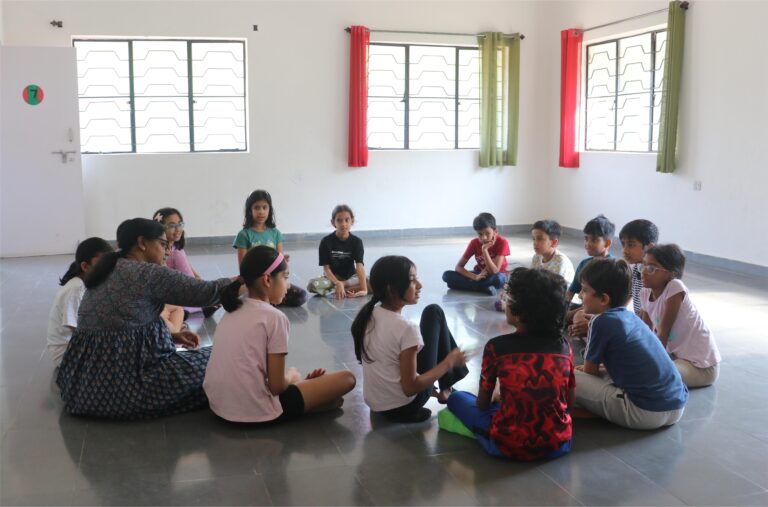
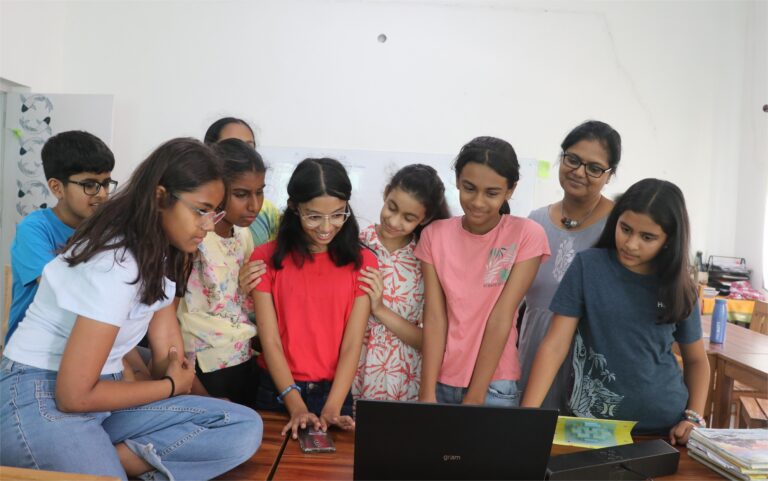
The children in this group tend to be very expressive and eager to learn. The learning space encourages their curiosity and offers opportunities for both exploration and expression, while engaging with traditional subjects.
Project work is now a blend of facilitator-led and student-led activities, allowing children to go beyond the basic requirements of the curriculum. Topics range from the diverse geography of India to its rich history. In line with the Integral philosophy of learning from near to far,
students gradually expand their understanding from their immediate surroundings to the
wider world. Science lessons explore inputs from our senses—like light, sound, and touch—
and foster curiosity about the human body and the plant world. Children are encouraged to express their understanding through a variety of formats, enriching their methods of
communication.
English and Math skills become more abstract to match the child’s growing cognitive
abilities.
In English:
Hindi, Telugu, Art, Handwork, Games, and Movement are also integrated to offer varied avenues for expression and skill-building. The children in this group tend to be very expressive and eager for learning. Work in this group becomes a space for quenching their thirst for learning and expression, while exploring traditional subjects.
Project work now is a mix of facilitator lead and student lead work, giving space for the children to expand their learning beyond the scope of the minimum class requirement. Topics in this group ranges from understanding the diverse geography of India to the history of India. In keeping with the Integral philosophy of learning from near to far, the children expand their learning to the country they are in. The sciences look into understanding the inputs from our sense, like light, sound, etc. With curiosity about their own body building in, these children explore the human body and the plant world around them. The children are encouraged to express their understanding in various format, thus expanding the expression methods.
English and Math skill work starts to become more abstract to keep pace with the child’s growing needs.
English language moves onto exploring poetry with longer narrative verses, writing of short stories, and analysing short novels, nonfiction texts and biographies. The emphasis now is on identifying themes, understanding structure and analysing characters. The writing now become more elaborate and glimpses of their own thoughts start to emerge. The expansion of vocabulary to sustain this growth, and bringing on figures of speech to enrich their expression is worked upon.
Math work goes onto working with whole numbers, fractions (including mixed, equivalent, and operations), and decimals. Emphasis on word and story problems continue as this integrates the ability to interpret language in order to apply mathematical concepts and solve problems. In Geometry, they identify shapes by edges and sides, explore properties of triangles, squares, rectangles, and circles, and learn the skill of using protractors and compass. Measurement includes area, perimeter and converting units. In Algebra, they go onto learning BODMAS, working with negative numbers.
Work on Hindi, Telugu, Art, Handwork, Games and Movement are worked upon to ensure use of these skills to express differently.
In English:
-
- Students delve into longer narrative poems, short story writing, and the analysis of short novels, nonfiction texts, and biographies.
- Emphasis is placed on identifying themes, understanding structure, and analyzing characters.
- Writing becomes more detailed, with children beginning to express their own voice and perspectives.
- Vocabulary is expanded, and figures of speech are introduced to enhance their expressive abilities.
-
- Students strengthen their understanding of whole numbers, fractions (including mixed and equivalent), and decimals through all four operations.
- Word and story problems are emphasized to integrate language and mathematical reasoning.
- In Geometry, they classify shapes by edges and sides, study properties of common shapes, and learn to use tools like protractors and compasses.
- Measurement includes calculating area and perimeter and converting between units.
- In Algebra, they begin to understand BODMAS and work with negative numbers.
Hindi, Telugu, Art, Handwork, Games, and Movement are also integrated to offer varied avenues for expression and skill-building. The children in this group tend to be very expressive and eager for learning. Work in this group becomes a space for quenching their thirst for learning and expression, while exploring traditional subjects.
Project work now is a mix of facilitator lead and student lead work, giving space for the children to expand their learning beyond the scope of the minimum class requirement. Topics in this group ranges from understanding the diverse geography of India to the history of India. In keeping with the Integral philosophy of learning from near to far, the children expand their learning to the country they are in. The sciences look into understanding the inputs from our sense, like light, sound, etc. With curiosity about their own body building in, these children explore the human body and the plant world around them. The children are encouraged to express their understanding in various format, thus expanding the expression methods.
English and Math skill work starts to become more abstract to keep pace with the child’s growing needs.
English language moves onto exploring poetry with longer narrative verses, writing of short stories, and analysing short novels, nonfiction texts and biographies. The emphasis now is on identifying themes, understanding structure and analysing characters. The writing now become more elaborate and glimpses of their own thoughts start to emerge. The expansion of vocabulary to sustain this growth, and bringing on figures of speech to enrich their expression is worked upon.
Math work goes onto working with whole numbers, fractions (including mixed, equivalent, and operations), and decimals. Emphasis on word and story problems continue as this integrates the ability to interpret language in order to apply mathematical concepts and solve problems. In Geometry, they identify shapes by edges and sides, explore properties of triangles, squares, rectangles, and circles, and learn the skill of using protractors and compass. Measurement includes area, perimeter and converting units. In Algebra, they go onto learning BODMAS, working with negative numbers.
Work on Hindi, Telugu, Art, Handwork, Games and Movement are worked upon to ensure use of these skills to express differently.