
Group 5: Ages 12-14 Years
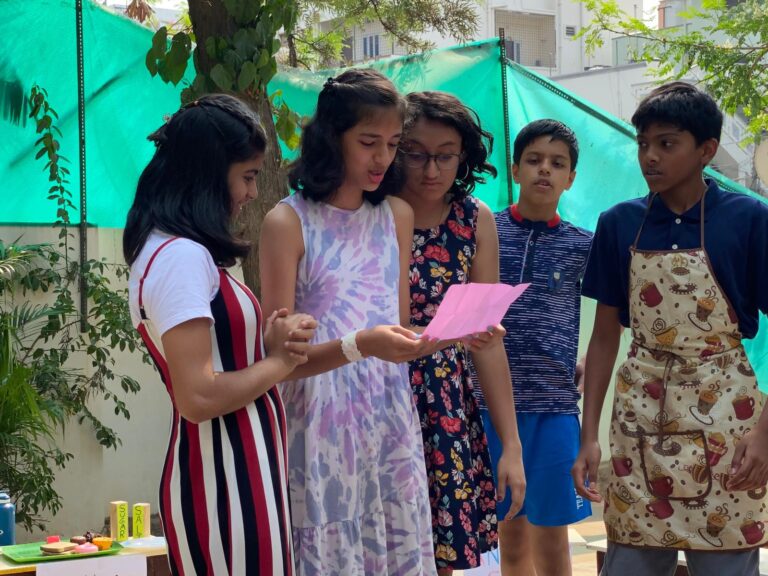
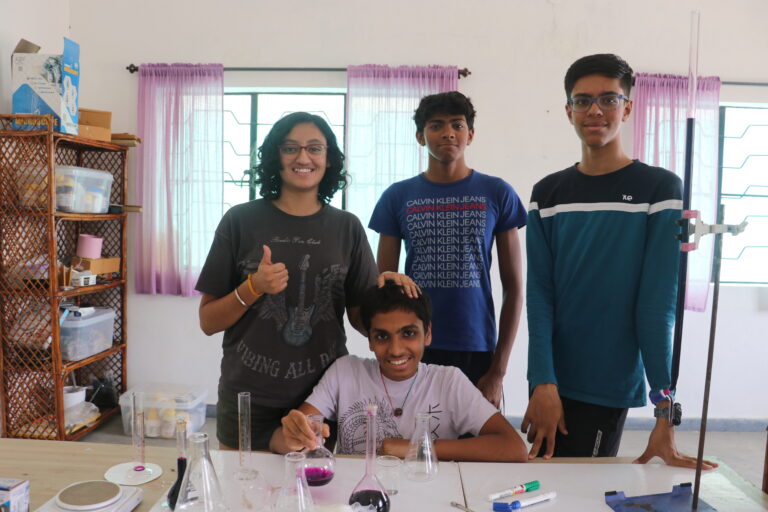
Children in this group begin to show a growing interest in the wider world. As their capacity for critical thinking develops, they also experience emotional turbulence due to intense developmental changes.
Engagement in art, movement, craft, and games provides healthy outlets for emotional
expression, while project work stimulates their curiosity and nurtures a hunger for more
abstract knowledge.
Project work now becomes more student-led, with facilitators stepping into the background to allow children to exercise independence and take on responsibilities. Through themes such as air and water, children explore geography, physics, chemistry, and biology in an integrated
way, fostering a holistic understanding of the deep interconnections between disciplines. This whole-to-part perspective evokes a sense of wonder, which in turn supports emotional
healing.
Projects also include civics-based themes, such as types of government and an understanding of the Indian political system. In science and geography, children engage with topics like motion, atoms, compounds, the human body systems, and weather patterns, broadening both their conceptual understanding and real-world awareness.
In English:
The children continue to work on their Hindi and Telugu skills.
In English:
- Students explore various forms of poetry including sonnets, free verse, odes, lyrics, narrative poems, and dramatic monologues.
- Reading focuses on comprehension, literary devices, and critical appreciation of age appropriate fiction novels and non-fiction passages.
- Drama is introduced through one-act plays and Shakespearean works.
- Engagement in reflective, persuasive, argumentative, and analytical writing—including letters, reports, and articles—while enhancing vocabulary with idioms and correct pronoun use is also worked upon.
- The children develop sentence structure using complex and compound forms, enhance punctuation skills with semicolons, colons, dashes, and ellipses, learn structured essay writing with clear paragraphing, and explore active and passive voice to refine tone and variety.
- Students strengthen their understanding of fractions and decimals and move onto understanding percentage, ratio and proportions
- Geometry learning includes a detailed study of the circle, exploring angle theorems within triangles, straight lines, and quadrilaterals and understanding the properties of parallel lines. They then move onto graphing straight lines calculating their slopes.
- In measurement they derive and apply formulae for are and surface are of 2D and 3D shapes, leading onto volume measurements. Understanding of 3D shapes a repeated units of 2D shapes is also explored.
- In Algebra the four arithmetic processes of algebraic expressions are explored, solving of algebraic equations and modelling of real life problems using these equations are worked upon.
- In Data Analysis students learn to collect and represent data using various visual tools like tally marks, bar graphs, circle graphs, line graphs, and pictographs, interpret this data through word problems, and calculate statistical measures such as mean, median, mode, maximum, minimum, and basic probability.
The children continue to work on their Hindi and Telugu skills.